Narrow Staircase Moves in Bellingham: Safe Handling Solutions
Posted on 18/06/2026
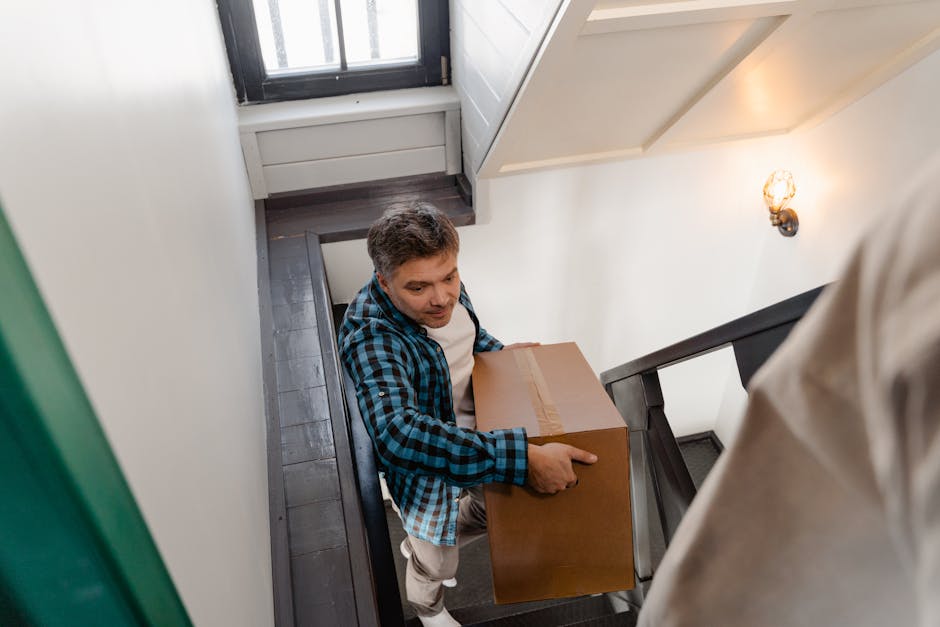
![An overhead view of an indoor staircase in a residential property showing two women involved in home relocation activities. One woman, wearing a plaid shirt, is seated on the stairs, lifting a large cardboard box, while the other woman, dressed in a light-colored coat, stands above her holding a similar-sized box. The staircase has black railings and dark wooden steps, with a white wall on one side and a small window leading to a well-lit interior space. A potted plant is placed on the windowsill, and a wall-mounted light fixture is visible on the wall beside the standing woman. Several cardboard moving boxes, some sealed with packing tape and one open with a framed photograph inside, are positioned on the stairs, indicating packing and moving preparations. The scene captures a typical furniture transport and packing process during a house removal, coordinated by [COMPANY_NAME].](/pub/blogphoto/narrow-staircase-moves-in-bellingham-safe-handling-solutions1.jpg)
Anyone who has tried to carry a sofa, wardrobe, bed frame, or even a heavy washing machine up a tight stairwell knows the feeling: you get halfway, the turn is awkward, the wall is inches away, and suddenly the job looks much bigger than it did in the lounge. Narrow staircase moves in Bellingham are exactly that kind of challenge. They need calm planning, good judgement, and proper handling solutions that protect your property, your belongings, and the people doing the lifting.
In Bellingham, you often see a mix of older flats, maisonettes, converted houses, and compact modern builds. Lovely places to live, but not always kind to large furniture. This guide breaks down how safe handling solutions work, what to watch out for, and how to decide whether a DIY attempt is realistic or whether a professional removal team is the safer call. If you are also planning the packing side of things, it can help to read how to organise packing for a quick move and this step-by-step clutter guide before the lifting even starts.
- Why it matters
- How it works
- Key benefits
- Who needs this service
- Step-by-step guidance
- Expert tips
- Common mistakes
- Tools and recommendations
- Best practice and safety
- Options comparison
- Real-world example
- Practical checklist
- Conclusion
- Frequently asked questions
Why Narrow Staircase Moves in Bellingham: Safe Handling Solutions Matters
Narrow staircase moves are not just "a bit awkward". They create a proper risk triangle: damage to the item, damage to the property, and injury to the people carrying it. The tighter the staircase, the more each movement matters. One missed pivot can chip plaster, scrape varnish, crack a banister, or twist a wrist. To be fair, even a piece of furniture that seemed manageable in the living room can become a completely different beast on the stairs.
In Bellingham, this matters because many homes have narrow landings, awkward angles, and staircases that were never designed with modern flat-pack furniture in mind. Add parking pressure, a last-minute move, or a rainy afternoon, and the stress climbs quickly. Safe handling solutions are about reducing that pressure with planning, correct lifting technique, protective materials, and the right crew size.
There is also a practical financial angle. A rushed lift can lead to broken furniture, wall repairs, or a second move later because the first attempt failed. That is why people often pair stairwell planning with broader move preparation, such as advice for reducing moving stress and proper box preparation from packing and boxes support in Bellingham.
Expert takeaway: if an item needs force to start moving, it usually needs a better plan, not more muscle.
How Narrow Staircase Moves in Bellingham: Safe Handling Solutions Works
The process starts well before anyone touches the item. A good move begins with measurement, route planning, and an honest look at the staircase itself. The team checks width, ceiling height, landing space, handrail position, turn radius, and whether the item can be tilted, stood upright, or dismantled. That sounds technical, but in practice it is simple: can the object physically travel through the route without scraping or jamming?
From there, the handling approach is chosen. A light but bulky item may need two movers, lifting straps, and a slow step-by-step turn. A heavier item may need it partially dismantled first. A delicate item may need wrapping, corner protection, and extra hands to control the pivot point. For some awkward pieces, the safest route is not up the stairs at all; it may be via an alternative entry point, balcony, or ground-floor transfer where available.
The right handling solution also includes protecting the staircase. That usually means floor runners, bannister wraps, doorframe guards, and careful communication between the crew. It is a bit like a choreographed manoeuvre, only with less elegance and more sweat. Still, when it is done properly, the difference is dramatic. You hear fewer bumps, see fewer scuffs, and the whole move feels calmer.
If you are moving especially awkward furniture, it can help to review related guidance such as moving a bed and mattress safely or protecting sofas for storage and transport. Those articles cover some of the same practical handling principles from a different angle.
Key Benefits and Practical Advantages
Safe handling solutions are not just about avoiding disaster. They make the whole move more efficient and less tiring. Once the route is mapped out and the method is clear, the crew wastes less time reversing, re-gripping, or stopping to reassess. That can save energy, protect the item, and reduce the number of people needed for the job.
Here are the most useful benefits in plain English:
- Less damage risk: careful wrapping, controlled lifting, and route planning reduce chips, dents, and scuffs.
- Lower injury risk: better technique means fewer awkward twists and fewer overreaches on stairs.
- Faster decisions: the team knows whether to dismantle, re-angle, or switch tactics.
- Better use of space: tight turns are managed with precision instead of brute force.
- More confidence on moving day: you are not standing there thinking, "This is never going to fit."
There is another practical advantage people sometimes miss: better handling usually reduces stress for everyone else in the property. Neighbours hear fewer knocks, hallways stay tidier, and the move feels less chaotic. That matters in flats, shared entrances, and narrow terraces where everyone is watching the stairs, whether they want to or not.
Who This Is For and When It Makes Sense
This kind of move is for anyone facing a staircase that makes conventional lifting a poor idea. That includes people moving out of top-floor flats, maisonettes with sharp turns, Victorian terraces with slim staircases, and homes where the landing is too small to rotate large furniture safely.
It is especially relevant if you are moving:
- large sofas or corner units
- wardrobes, chests of drawers, and tall bookcases
- beds, mattresses, and divan bases
- pianos or other heavy, fragile items
- appliances such as freezers or washing machines
- student contents where time is short and access is tight
It also makes sense for landlords and tenants who need to avoid property damage on move-out day. A narrow staircase can be the deciding factor between a smooth handover and a slightly painful repair conversation. If you are a student with a small setup, you may find student removals in Bellingham a useful fit. If you are dealing with a full household, house removals support is often the better route.
Sometimes the answer is simple: if the item is valuable, oversized, awkwardly shaped, or sentimental, it is usually worth getting the handling right first time. You only get one chance not to scrape the stair wall. Well, most days anyway.
Step-by-Step Guidance
Below is the practical order that tends to work best on real moves. It is not flashy. It is just the sort of method that avoids unnecessary drama.
- Measure the item and the route. Check width, height, landing space, and any turns. Don't eyeball it if the item is bulky.
- Clear the staircase. Remove mats, picture frames, plants, and anything that creates a trip hazard. Open doors fully.
- Protect surfaces. Use covers on floors, bannisters, and corners. A small scrape takes seconds; fixing it takes longer.
- Decide whether to dismantle. Remove legs, shelves, handles, or doors if that will reduce width or weight.
- Wrap and secure. Blankets, shrink wrap, and tape help prevent damage, but do not tape directly onto delicate finishes.
- Assign roles. One person leads, one stabilises, and one watches clearances. Too many voices, and the job gets messy.
- Lift slowly and communicate. Use short commands like "up", "pause", "pivot", and "down".
- Use the landing as a reset point. Do not try to force the turn in one movement if the landing is tight.
- Reassess if it binds. If the item catches, stop. Re-angle, re-wrap, or change the plan.
- Finish with a check. Look at the item, the stairwell, and the hallway before moving to the next piece.
A useful rule of thumb: if you need to hold your breath for the lift, the lift is probably too ambitious. That sounds obvious, but people forget it in the moment.
Expert Tips for Better Results
There are a few small habits that make a big difference. First, dress for the job. Grip matters, and shoes with decent soles are better than anything slippery or loose. Second, avoid rushing the first item. If the first sofa goes well, the rest of the move often settles down too. If it goes badly, the whole mood can dip. Strange but true.
Another tip: think in terms of angles, not just strength. A wardrobe may fit when slightly tipped, then suddenly snag when it is flat. A mattress may be easy to carry upright but awkward if it bends too much. That is why experienced movers are constantly making tiny adjustments rather than one huge lift.
Some of the most helpful behind-the-scenes prep comes from cleaning and decluttering. A cleaner route reduces slips, and fewer items mean fewer decisions. If you want to tidy as you pack, these simple pre-move cleaning tips pair well with a clutter-clearance plan.
- Keep tools and wrap close to the stairs before the move starts.
- Photograph the item before dismantling so reassembly is easier later.
- Use a second person as a spotter on blind corners.
- Pause for breath on the landing rather than fighting the turn.
- Protect corners before the item reaches the narrowest point, not after.
And one more, slightly boring but important: communicate early if you feel the item shift. People try to "save face" and carry on. That is how silly accidents happen.
Common Mistakes to Avoid
The biggest mistake is assuming that "strong enough" is the same thing as "safe enough". It is not. Strength helps, of course, but tight stair moves are mostly about control, balance, and planning. Another common mistake is failing to measure properly. A few centimetres can be the difference between a smooth carry and a stuck item on the landing.
Other mistakes crop up again and again:
- Forcing the turn: this is where walls, banisters, and knuckles suffer.
- Skipping protection: even a light scrape can become a costly repair.
- Using the wrong team size: too few people creates strain; too many makes coordination harder.
- Ignoring the item's balance point: some items carry best upright, others tilted.
- Leaving loose parts attached: handles, shelves, or legs can snag at exactly the wrong moment.
- Starting without a route test: walk the route first, ideally with the item dimensions in mind.
For bigger or more fragile items, DIY can become a false economy. That is why people often decide against moving pianos or larger furniture alone. If you are weighing that up, this guide on DIY piano moving is a useful reality check.
Tools, Resources and Recommendations
You do not need a warehouse of specialist kit, but the right basic tools make a big difference. In many narrow staircase moves, the best results come from a modest set of equipment used well.
| Tool or resource | Why it helps | Best use |
|---|---|---|
| Removal blankets | Protect surfaces from knocks and friction | Large furniture, banisters, tight corners |
| Stretch wrap | Keeps drawers, doors, and loose parts in place | Wardrobes, sofas, divan bases |
| Lifting straps | Improves control and spreads weight more evenly | Heavier items with a stable shape |
| Corner protectors | Reduces damage to walls and painted edges | Sharp turns and narrow landings |
| Removal van with loading space | Keeps the move efficient and reduces repeated lifting | Multi-item household moves |
For general move preparation, it can also help to look at the full services overview and, if your move is time-sensitive, same-day removals in Bellingham. If you need a smaller, more flexible setup, man and van support is often a practical fit.
Recommendation-wise, use proper packing materials, keep fragile items separate, and avoid overfilling boxes. Weight that is easy on the flat becomes horrible on the stairs. Oddly enough, gravity doesn't negotiate.
Law, Compliance, Standards, or Best Practice
For moves involving narrow staircases, the key compliance issue is usually health and safety rather than a single special rule. In the UK, the expectation is that moving work should be carried out in a way that reduces avoidable injury and property damage. In practical terms, that means careful risk assessment, sensible manual handling, and appropriate equipment for the task.
Good practice usually includes:
- checking whether the item can be dismantled before lifting
- using enough people for the weight and shape involved
- keeping stairways and exits clear
- wearing suitable footwear and gloves where needed
- avoiding lifts that create twisting, overreaching, or loss of balance
It is also sensible to think about building access and neighbour safety. Shared hallways, communal stairwells, and older properties often need extra care. If you are using a mover, it is worth checking their insurance and safety approach and their health and safety policy. That is not red tape for the sake of it; it is the bit that protects everyone when something unexpected happens.
Best practice also includes honesty. If an item is too large for the staircase, the correct answer is not optimism. It is a different method.
Options, Methods, or Comparison Table
Different stairwell challenges call for different solutions. The table below compares the most common approaches so you can decide what feels realistic.
| Method | Best for | Pros | Watch-outs |
|---|---|---|---|
| DIY carry with family or friends | Light to medium items, short distances | Low cost, flexible, quick to arrange | Higher injury risk, inconsistent technique, limited experience |
| Professional man and van team | Small to medium moves, mixed access, time pressure | Efficient, adaptable, generally less stressful | May still need pre-planning for very awkward items |
| Specialist furniture removal | Bulky, heavy, or awkward items | Better handling, better protection, more confidence | Usually costs more than a basic lift |
| Disassembly and rebuild | Wardrobes, bed frames, large shelving, some sofas | Often the safest route through tight spaces | Needs tools, time, and care with fixings |
In real life, the best move often blends two methods. A sofa may be dismantled, the bed moved by a small team, and the rest handled as part of a general removals visit. That is why furniture removals in Bellingham and flat removals support can be more useful than trying to force everything into one approach.
Case Study or Real-World Example
Picture a typical Bellingham flat move: third-floor access, narrow internal stairs, one landing that barely gives you room to turn, and a bulky sofa that looked perfectly ordinary in the living room. On paper, the sofa is the easiest item in the home. On the stairs, it is suddenly the awkward one.
In a practical scenario like this, the team would first check whether the feet or arms could be removed. If yes, that immediately improves the chances of a clean turn. Then the staircase would be protected at the corners, and the sofa wrapped to stop scuffs from the wall and bannister. One person would lead the upper end, another would control the lower weight, and a third would watch the landing angle. Slow, deliberate, slightly sweaty. That is usually how the good jobs go.
What made the difference was not force. It was preparation. The sofa moved on the first attempt because the route was measured and the plan was realistic. In contrast, when people try to "just have a go", they often end up with the item stuck sideways, tempers up, and a wall mark that was not there ten minutes earlier.
On a similar move, a resident might also choose to store items temporarily while the stair access is sorted. If that sounds familiar, storage options in Bellingham can be a sensible backup when access or timing is tricky.
Practical Checklist
Use this checklist before you attempt any narrow staircase move. It keeps the job grounded and stops the whole thing from turning into a late-night puzzle.
- Measure the item and the staircase route.
- Check landing space and turn angles.
- Clear stairs, hallways, and doorways.
- Protect floors, walls, bannisters, and corners.
- Remove detachable parts where sensible.
- Wrap furniture and secure loose sections.
- Assign one lead mover and one spotter.
- Agree on short communication commands before lifting.
- Confirm parking or van access before the load starts.
- Keep water, gloves, and tape close at hand.
- Stop immediately if the item binds or tilts dangerously.
- Have a fallback plan if the staircase is simply too tight.
Small checklist, big difference. Honestly, it saves arguments as much as it saves time.
If your move involves awkward access, fragile furniture, or a tight deadline, it is usually worth choosing a careful, well-planned approach rather than hoping muscle alone will solve it. A move that feels controlled from the first lift tends to stay controlled all the way through.
Get a free quote today and see how much you can save.
Conclusion
Narrow staircase moves in Bellingham are challenging, but they do not have to be chaotic. With the right handling solution, a tight staircase becomes a manageable route rather than a problem to fear. Measure first, protect the route, choose the right lifting method, and be honest about when an item needs specialist help.
The biggest lesson is simple: safe handling is not about being cautious for the sake of it. It is about making the move cleaner, faster, and less stressful for everyone involved. That is a better outcome for your furniture, your walls, and your peace of mind. And let's face it, on moving day, peace of mind is worth a lot.
When you plan it properly, even the tightest stairwell can be handled with calm, confidence, and a bit of patience. That is the sort of move people remember for the right reasons.
![An overhead view of an indoor staircase in a residential property showing two women involved in home relocation activities. One woman, wearing a plaid shirt, is seated on the stairs, lifting a large cardboard box, while the other woman, dressed in a light-colored coat, stands above her holding a similar-sized box. The staircase has black railings and dark wooden steps, with a white wall on one side and a small window leading to a well-lit interior space. A potted plant is placed on the windowsill, and a wall-mounted light fixture is visible on the wall beside the standing woman. Several cardboard moving boxes, some sealed with packing tape and one open with a framed photograph inside, are positioned on the stairs, indicating packing and moving preparations. The scene captures a typical furniture transport and packing process during a house removal, coordinated by [COMPANY_NAME].](/pub/blogphoto/narrow-staircase-moves-in-bellingham-safe-handling-solutions3.jpg)